
Wort is the liquid you make that then gets turned into beer by fermentation. It smells and tastes like a very sweet, malt based liquid.
Krausen is the foamy head that is created on top of the wort during fermentation. This can harden after the fermentation process is complete and can be a bit tricky to clean off your fermenter in some instances. During very vigorous fermentation, the krausen can fill the headspace (the remaining space above the wort) completely to the brim, and sometimes even make it’s way through the airlock! Some beer/yeast combinations will barely create any krausen, so don’t worry if it doesn’t appear, or is very small.
Once your wort has finished fermenting and turned all available (fermentable) sugars into alcohol, you may want to “cold crash” your beer. This is simply the process of chilling the fermented liquid down to low temperatures, often near freezing. This makes the yeast in the liquid flocculate (clump together), which results in much of the yeast falling to the bottom of the fermenter, resulting in a clearer beer. Cold crashing is not necessary, especially when starting out. There is no real evidence that a clearer beer is a better tasting beer, so your first beers may be cloudy, but will still be tasty!
That’s the “Trub”. It’s a mixture of dead/inactive yeast, plus some other non-fermentable bits and pieces. You don’t want to drink it, but it’s not the end of the world if a little gets into your beer. Fun fact, if you’re trying to brew beer on a budget, you can throw a fresh batch of beer into the fermenter straight on top of that trub, which will allow you to re-use it. This saves you buying more yeast. Please note, this is probably not something you want to try for your second batch ever!
To calculate the ABV of a home made beer, you need to know the Original Gravity (OG), and the Final Gravity (FG), then you do a quick calculation. If we could be bothered doing the maths, the equation would look something like this: ABV = (OG – FG) * 131.25
In reality, most people just download the Brewfather app, or use an online calculator.
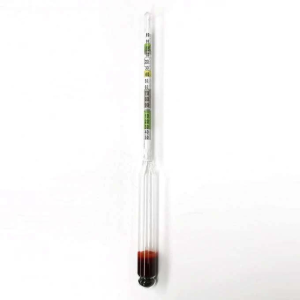
To obtain the OG and FG, most beginners will use a simple, cheap, glass Hydrometer. This will float higher in liquids with a higher sugar content. As the yeast in the wort convert sugar into alcohol, as the beer converts, the Hydrometer will float lower in a sample. The readings are all in the format of 1.XXX (eg; 1.056) and most beers will finish fermentation somewhere around the 1.010 mark (but not always!).
if we were to use the formula above, the example would be 6.04% alcohol by volume. Eg: (1.056-1.010) * 131.25 = 6.04.
Heck yea! Some states are a little iffy about distillation of alcohol, as that can be a bit more troublesome if you don’t know what you’re doing. Beer/mead/wine/cider has no laws about producing it for your own consumption. Just be aware that the minute you try to sell it, then you’re in a whole new world of legal mess as you’d require a Liquor License.
For the purpose of this question, there are two types of yeast (there’s lots more, but we’re keeping it simple).
An Ale yeast can stand higher temperatures and normally likes to sit around 20-25 degrees C.
A Lager yeast is a lot more chilled and ideally sits around 12-16 degrees C.
Typically you don’t want to exceed these temperatures too far, or you can end up with some weird flavours and smells, but there are exceptions to the rules. When you’re starting out, try to stick to the rules as much as possible.
There are some “specialty” yeasts that may work for you if you need to ferment in environments that you have no control of temperature. Kveik yeast for example will happily work all the way up to 40 degrees C!
The normal rule of thumb is that your beer will have the same FG for two days straight, and there is no bubbling in the airlock. This typically will get your Final Gravity somewhere near 1.010, but it could be higher or lower. If the gravity reading is way off (perhaps something like 1.028), then you may have a stalled fermentation. It could be too cold for the yeast to properly do their work, or the yeast may not like the environment due to pH or similar.
If this happens, you typically give the fermenter a good shake, and try to raise the temperature a degree or two. In some circumstances you may need to throw more yeast or a yeast nutrient to get things going again. Thankfully stuck fermentations are pretty rare with simple kits.
Well firstly; grow a pair and suck it up.
Secondly, it’s actually pretty simple to make ciders and seltzers too. We love a good home made Ginger Beer on tap in our household, plus we have friends who only make simple “washes” (basically alcoholic water), so they can mix their fancy cordials in. Really, just about anything with sugar (naturally occurring or added) in it can be fermented, however some environments need a little TLC to get them to become friendly for the yeast.